
By: Brandon Bossenbeger
/
Reading time: 11 min.
Many think “Mobile Hunting” is only for the grueling, run-and-gun public land hunters. Those with private land access do not need to have a mobile strategy– they have the luxury of leaving their treestands and equipment without worrying about locks and chains to prevent expensive gear from getting stolen. But if you look closely at how the most consistently successful whitetail hunters are operating today, that mindset has changed.
Mobile hunting is rapidly becoming the ultimate strategy for maximizing success on private land and hunting leases. If you are paying good money for exclusive access to a property but still relying entirely on a handful of permanent stands, you could be missing out on opportunities to harvest your biggest bucks.
Here is why adopting a mobile hunting strategy on your private dirt or leased ground is one of the biggest competitive advantages you can have this season.
Locked to the "Lock-On" Stand
When you finally secure a great hunting lease, the first instinct is usually to walk the property and start hanging your treestands. You find the best pinch points, field edges and funnels, set up a few ladder stands or heavy hang-ons, clear some shooting lanes, slap up a few cameras and wait for the hunting season to start. There’s no denying that the first sits in these spots can be killer, but what happens when you don’t shoot the big buck you’re after in your first few hunts at these spots?
Every time you walk to that same permanent stand, you leave a ground scent. Every time you climb up, you leave a scent profile near that tree. Just after a few sits the deer seem to know exactly what trees your ladder stands are in. Especially true if you have a negative encounter with deer- whether they pick you off moving, bust your scent, or spook on your way in/out of hunting. If a specific treestand is overhunted or hunted on incorrect winds, the deer on that property will become educated, instinctively looking up to scan for hunters before stepping into the open.
Mature whitetails pattern hunters much faster than hunters pattern them. Mobile hunting allows hunters to hang in new and different trees. It allows them to hunt locations or trees they may not have been able to, due to tree size or wind directions. You can bounce around the property based strictly on the current wind and fresh sign. Permanent setups create a false sense of security. You end up hunting memories—the spot where you saw a shooter three weeks ago—rather than adapting to where the deer are today.
Changes to the Whitetail Woods
Whitetail patterns are shifting drastically throughout the fall. There are many determining factors that may cause a mature buck to shift his movement patterns and locations. Just as the movements and patterns shift, your hunting locations and strategies also need to adapt and shift. Below are a few reasons why the buck you’re chasing this season may be "disappearing".
Hang and Hunt: Hunting “The Now”
The most effective way to hunt changing deer patterns is through mobile hunting. A mobile setup—whether that’s a modern tree saddle, an ultra lightweight hang-on stand paired with lightweight climbing sticks, or the old climber—allows you to strike exactly where the action is happening right now.
The best way to determine where that “right now” action is on your property, is to scout.
"Observe and Strike" : This method is very conservative and non-invasive. It is imperative to set up in a location where you can access cleanly (pre and post hunt), blow you wind in a direction where you aren’t spooking any deer, and where you can see a long way. The goal is to get eyes on the buck that you are after, by glassing and observing from a far– without him knowing. Watch where that buck is coming in and out of; drop pins on your e-scouting apps to mark these locations. Study the terrain and mark a location where you will be able to make a play on that deer. Then when the time is right (mid day) make your move. Keep in mind where your scent is blowing, and how you access. You still want to hunt cleanly and be surgical when you are picking your next spot. This ensures if you don’t kill the buck, you are not blowing up the property to get out for the night (or in for the morning).
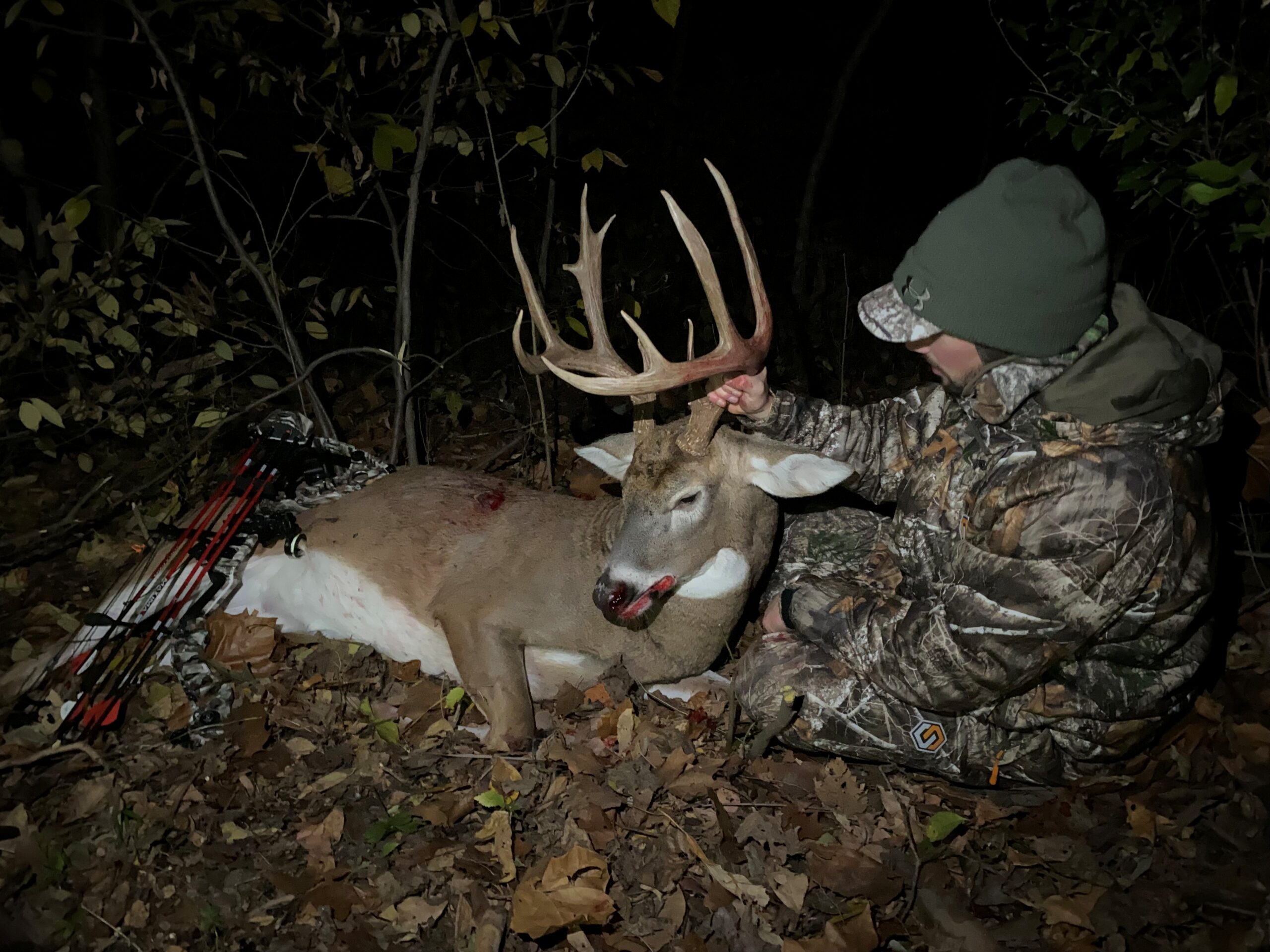
On November 1st, 2025 I was able to harvest a 5 year old buck using the “Observe and Strike” method. On the morning of October 31st I sat in an observation stand overlooking a cut cornfield. About 400 yards away I saw the buck with the broken ear- my target buck “Droopy”. Droopy made a scrape along the field edge and then disappeared into the woods. That evening, I hung my mobile hang-on stand along the same field edge as where I saw Droopy that morning. However, I did not go to the exact location where I saw him, knowing that my access to leave the stand in the evening would not be sufficient. I opted to hang in a spot where I could get out cleanly, but still in the game. That night I saw several nice bucks, but no Droopy. On the morning of November 1st, I went back to the observation stand and watched my target buck do the same thing he did the prior morning. Around mid day, I used the creek bottom running through the woods on the property as access to get to the outskirts of where I thought Droopy might be bedding. Around 5:20pm I heard thrashing in the thick brush and out came two small does, followed by their mother and a giant wall of tines. The fawns walked 20 yards past my mobile set up and brought Droopy and the doe down the trail with them. He stopped perfectly broadside and I watched my arrow disappear behind his front shoulder.
"Read and React": This method is more on the aggressive side, but still can be very effective at the right time of the year. Simply put, you are boots on the ground scouting with your mobile set and weapon. Depending on your gear and what style you are using, you can strap your platform and sticks to your back or backpack –freeing your hands. As you are scouting your way in, keep your eyes peeled for fresh tracks, new rubs, scrapes, beat trails, beds and new deer signs. You should try to scout quietly and move slowly, to disturb as little as possible. There is a good chance that you may jump some deer while you are walking in. Take note of what you just jumped, if it was a "shooter" buck do not panic. Try to find where he was bedding and get set up on the down wind side of where the bed was. Give this spot at least an evening and a morning sit if possible. There is a good chance he will come back to check what the disruption was, or to use that bed again. This style is also referred to as “Bump and Dump” hunting, originated by Andrae D’Aquisto- the inventor of the ultra light weight mobile hang-on stand, Lone Wolf Custom Gear.
However, there is a possibility that you scout your way in and do not bump any deer. You should continue to look for fresh deer signs and areas that could provide an opportunity at a mature buck. When you do find a spot that looks and feels “bucky”, it’s time to find the right tree. Consider the wind direction and thermals, tree cover and shooting lanes when picking the right tree to set up in. Try to avoid hanging in trees with loud flaking bark like the Shagbark Hickory or Black Cherry trees. These trees are not un-huntable, but your straps and clothes tend to get stuck on the bark while hanging in them. A midsize Oak tree is one of my favorite trees to hunt in. They often have many young lower branches along the trunk and tend to hold their leaves well through the season, allowing for optimal cover. Their bark is also soft enough for the teeth of your saddle platform or treestand to bite into the tree and provide a sturdy, safe hunt.
Making the Transition: Gear for the Mobile Hunter
You don't need to abandon your permanent stands entirely. A smart lease strategy utilizes a few low-impact, easy-access permanent stands for observation sits or quick after-work hunts. But having a mobile set in your truck gives you the ultimate advantage.
If you are building a mobile kit for your lease this year, focus on stealth and weight:
- The Tree Saddle: Saddles have revolutionized the mobile hunting game. Saddles weigh mere ounces, allowing for easy pack ins, and quiet set ups. They help you conceal your body behind the trunk of the tree to avoid being skylined, and you can shoot 360 degrees around the tree. You also have the advantage of hanging in smaller diameter and crooked trees- trees you would not be able to hunt out of with traditional hang-on stands and ladder stands.
- Lightweight Hang-Ons: If you prefer a traditional platform feel, ultra-lightweight hang-ons have become incredibly comfortable and easy to pack. Systems like Lone Wolf Custom Gear and Novix Treestands allow you to quietly attach your climbing sticks and your backpack to the stand and have padded backpack strap options to carry on your back, freeing your hands. Today's mobile stand options provide comfort with padded seat cushions, adjustable seat heights and multiple platform size options.
- Climbing Methods: Ditch the heavy steel, large segmented climbing sticks. Look into strap-on carbon fiber or lightweight aluminum climbing sticks. Many mobile hunters also incorporate "aiders" (webbing loops that attach to the bottom of a climbing stick) to gain more height with less gear. Screw-in tree pegs can also be an alternative option for mobile hunting.
Remember to carry a hand saw when mobile hunting. You will likely need to trim a few shooting lanes or branches to get into the perfect kill tree. Always check with the landowner before using screw-in pegs, sawing or cutting anything on their property. Something as simple as cutting a few branches for shooting lanes, may be the reason the landowner stops leasing out their property.
Conclusion: Evolve Your Strategy
Ultimately, transitioning to a mobile strategy isn’t about abandoning the convenience of your set stands. It should be utilized as another option and tool in your hunting arsenal. When you break free from the constraints of permanent stands, you stop hunting the history of a property and start hunting the reality of it. By choosing to be adaptive, you regain the ability to work the wind in your favor, react to changing food sources, and slip into the "fringe" spots that mature bucks think are safe. This season, don’t just settle for the old ladder stand; gear up, stay light, and be ready to move.