

By: Brandon Bossenbeger
/
Reading time: 10 min.
Nearly every major timberland owner in the country already monetizes hunting access. That’s the first thing worth clearing up before comparing vendors and models: the question for a TIMO, timber REIT, or family forestry company in 2026 isn’t whether to lease hunting rights on managed timberland — it’s how well the program currently running is actually working.
Weyerhaeuser, Rayonier, and Westervelt each run large, well-established recreational leasing operations, and each has done so for decades. They’re worth studying not because their programs are broken, but because their scale is what makes the cracks visible. What works when you own 5 million acres and can staff a dedicated recreation division looks very different from what a mid-size timber company or a TIMO with a few hundred thousand acres can realistically replicate in-house. This article walks through how the three biggest in-house programs are structured, where the model tends to break down below that scale, and what a specialist broker does differently.
It’s worth being precise about who this comparison is actually for. The timberland ownership landscape splits into two groups: companies that already run some form of hunting lease or recreational-access program — in-house, through a licensing platform like RLMS/Orbis or My Outdoor Agent, or via a generalist forestry consultant — and a smaller group of family timber companies, newer TIMO acquisitions, and funds that haven’t monetized hunting rights at all. If your organization falls into the second group, the more useful starting point is the category-level question of whether to begin a program in the first place. This article speaks to the first group: asset managers, land management teams, and foresters at companies that already have a program running and want an honest read on how their model compares to the alternatives, including the fully managed broker route.
How Weyerhaeuser Runs Its Program
Weyerhaeuser owns more than 5 million acres in the U.S. with over 4 million of those acres concentrated in the Southeast, and it manages recreational access through its own Recreational Lease Management (RLM) program (recreation.weyerhaeuser.com). Hunters and clubs search available tracts directly through the company's recreation portal, accept a standardized lease contract, and submit payment — typically within seven days of the lease being offered — before any hunting activity is permitted on the property.
The RLM structure is built for volume. Subleasing, commercial hunting, and reselling of hunting rights are explicitly prohibited, and the program leans on published guides — Weyerhaeuser publishes a regional Hunting Lease Guide for its South Region operations — to standardize terms across thousands of individual leases. Weyerhaeuser also runs a parallel permit system alongside its leases for shorter-term or single-activity access, which adds a second set of terms and a second self-service workflow for the company's recreation team to maintain.
It's a genuinely well-run operation, and it's only possible because Weyerhaeuser has the scale to justify building and staffing an entire recreation division as a standing part of the business — one with its own web portal, its own published guides by region, and enough transaction volume to make that infrastructure pay for itself. A company managing a few hundred thousand acres doesn't generate enough lease volume to justify that same investment, which is exactly the calculation that pushes most of the market toward either a licensing platform or a managed broker instead of a bespoke internal system.
How Rayonier Runs Its Program
Rayonier licenses roughly 1.9 million acres annually for hunting and recreation across Florida, Georgia, Alabama, Louisiana, Texas, Oregon, South Carolina, and Washington through its Rayonier Hunting and Recreation platform (rayonierhunting.com). Access is sold through license agreements to individual hunters and hunt clubs, with terms — including whether cabin access is included, and what weapons or methods are permitted — varying by tract and region.
Following Rayonier's January 2026 merger with PotlatchDeltic, Rayonier is now also administering the legacy PotlatchDeltic large-tracts recreational access program alongside its own. That consolidation is worth watching closely: when two timber REITs with separately built licensing programs merge, the surviving entity inherits two sets of vendor relationships, two lease templates, and two pricing structures to reconcile. It's a preview of the kind of administrative complexity that shows up anywhere a portfolio grows faster than the recreation program managing it — whether through M&A or straightforward acreage acquisition. (Program specifics here are current as of mid-2026 and worth reverifying directly with Rayonier before citing in any partner-facing material, given how recently the merger closed.)
For an asset manager evaluating Rayonier's model as a benchmark, the more useful question isn't how the license agreements read today — it's how quickly the combined program gets normalized across the newly merged portfolio. Reconciling two pricing structures and two sets of lessee records across nearly 2 million acres is not a small integration task, and it's the kind of work that falls on the same land management staff already responsible for the timber side of the business during a merger. It's a good illustration of how recreational leasing complexity doesn't stay flat — it scales with every acquisition, divestiture, or portfolio change a company goes through.
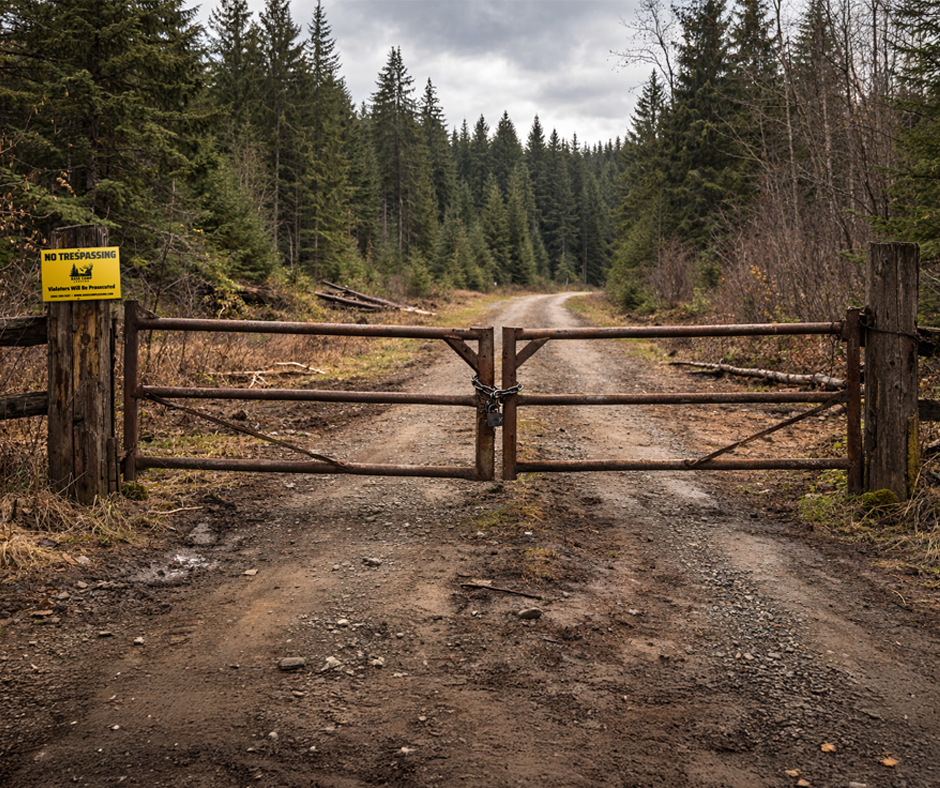
Logging road leading to timber cut site.
How Westervelt Runs Its Program
Westervelt Wildlife is the oldest of the three programs by a wide margin — the company hired the Southeast's first private wildlife biologist in 1951 and launched one of the region's earliest hunting lease programs in the 1970s. Today Westervelt manages nearly 600,000 acres of hunting leases across Virginia, Georgia, Mississippi, Florida, South Carolina, and Alabama (westerveltwildlife.com).
What sets Westervelt apart is depth of staffing relative to acreage: the company employs Certified Wildlife Biologists and hunting lease managers with a combined 100-plus years of experience, and it caps membership at one hunter per 100 acres to protect hunt quality. Clubs collect harvest and hunter-observation data annually, and Westervelt layers active forestry work — thinning, prescribed burning, food plots — directly into its wildlife management strategy. Timber harvests are kept to less than 100 acres on average, and at least 1% of ownership is dedicated to permanent food plots, which are operational commitments most timber companies aren't set up to make without a standing wildlife team already in place.
It's less a licensing platform than a genuine wildlife consultancy with a leasing arm attached, and that depth of service is exactly what's hardest for a smaller land management team to replicate without dedicating comparable headcount to a function that isn't timber production. Westervelt's model also underscores a point that gets lost in vendor comparisons: a hunting lease program is only as good as the people running it day to day. A biologist-staffed program built over 70-plus years is a genuine competitive advantage, not something a company can stand up quickly by licensing software or assigning the task to an already-stretched forestry team.
Where the In-House Model Breaks Down
All three programs share a structural trait: they were built by companies large enough to treat recreational leasing as its own internal business line, with dedicated staff, standardized paperwork, and — in Weyerhaeuser's and Westervelt's cases — decades of accumulated process. That's precisely what makes them hard to benchmark against if a company doesn't have Weyerhaeuser's scale or Westervelt's specialist bench.
A few friction points show up consistently once you look past the flagship programs at how the broader industry — mid-size timber companies, newer TIMO acquisitions, family forestry operations — actually runs recreational access:
None of this means Weyerhaeuser, Rayonier, or Westervelt are doing it wrong. It means their model — build the function in-house, staff it permanently, run it at scale — is the right answer for companies with the acreage and headcount to support it, and a genuinely difficult one to replicate below that threshold. The honest self-assessment for any other timberland company or TIMO is less “are we running a program” and more “does our program have the staffing depth these three companies do, or is it running on borrowed time from people whose real job is somewhere else.”
Where a Specialist Broker Fits
This is the gap a dedicated hunting lease broker like Base Camp Leasing is built to close for companies that don't want to stand up an internal recreation division from scratch. The structural differences are straightforward:
| Point of Comparison | In-House Program | Base Camp Leasing |
|---|---|---|
| Program Model | Internal team runs marketing, screening, collections, and renewals | Fully managed — Base Camp Leasing handles the entire lifecycle |
| Liability Insurance | Varies by program; often no included policy | $5M general liability policy on every lease, landholder named as additional insured |
| Pricing | Set once, rarely revisited | Market-driven, with a standard 5% automatic annual increase |
| Point of Contact | Internal forester or land manager (recreation is a side duty) | Single dedicated corporate account manager |
| Cost to the Company | Staff time and/or software licensing fees | None — paid via commission collected from hunters, not the landholder |
| Track Record | Program-specific | 26 years in business, $80M+ paid to landowners, 6.5M+ acres under active licensing |
Base Camp Leasing's Timber Investor program was built around exactly this gap — timberland and rural land held for investment purposes that's generating no recreational income at all, or income capped by an under-resourced internal process. The same fully managed structure already runs for aggregate and mining land holders sitting on comparable non-operational acreage, and every lease carries the $5 million liability policy with the landholder named as additional insured — the detail that separates a program from a piece of paper.
The difference shows up most clearly in what happens after a lease is signed. A named account manager means renewals, insurance certificates, and hunter compliance are someone's full-time responsibility rather than an item on a forester's list. Access is limited to a paid membership base, so every hunter on the property is a named party to a signed agreement rather than an open inquiry the company has to vet itself. And because pricing is reviewed against market data rather than set once and left alone, a standard 5% annual increase is built into every lease rather than depending on someone remembering to revisit it. For a company already running an in-house program, none of that requires tearing anything down — it's a question of whether the current setup is actually capturing what the land is worth, or whether it's been running on autopilot since it was first put in place.
The Real Question for 2026
Weyerhaeuser, Rayonier, and Westervelt prove the category works at scale. The open question for every other timberland company and TIMO is whether an internal program — or a software platform layered on top of internal staff — is actually keeping pace with what the land could be earning, or whether it's quietly absorbing time and risk that a specialist partner is built to take off the table entirely.
For companies already running a program and wondering how it stacks up against the alternatives, the next articles in this series compare Base Camp Leasing directly against the two software platforms most commonly used to administer in-house leasing: RLMS/Orbis and My Outdoor Agent.